Collard Greens

Enoki

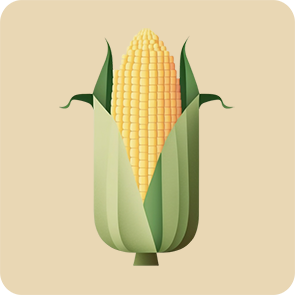
Corn
Sweet, juicy, and satisfying, corn is more than just a summer favorite—it's a whole grain that provides energy, fiber, and key nutrients. Whether on the cob, in a salad, or ground into flour, it’s incredibly versatile.
100
medium ear
(100 grams)
CAL
A
Nutri-Score
Moderate in calories, a good source of fiber and essential nutrients like B vitamins and antioxidants. Naturally gluten-free.
Value per 100 grams & per cup (165g):
100 kcal / 160 kcal
Protein
3.5 grams / 5.5 grams
Fats
1.5 grams / 2.5 grams
Carbohydrates
20 grams / 35 grams
Fiber
2.5 grams / 5 grams
Vitamins & Nutrients
Satiety and Feelings
Corn is satisfying due to its combination of carbs and fiber, offering a steady source of energy. It has a naturally sweet flavor and a tender bite that makes it a comfort food for many.
What does 100 g look like?
About 2/3 of a medium cob or half a cup of kernels.
What does 2000/2500 calories look like?
Roughly 25 corn cobs (around 3 kg cooked kernels).
Daily Value per 100 grams %
Vitamin B1
15%
Vitamin B5
10%
Vitamin B9 (Folate)
10%
Magnesium
10%
Fiber
10%
Protein
5%
Sodium (Salt)
0%
Carbohydrates
5%
Total Fat
2%
Saturated Fat
Saturated Fat
1%
Cholesterol (free)
0%
Sugar (natural)
Sugar
5%
Calories
5%
Did you know?
- Corn is both a vegetable and a grain, depending on how it’s used—fresh corn is a veggie, while dried corn (like popcorn) is a whole grain.
- Corn is native to Central America, first domesticated by indigenous peoples (who call it Maize) over 9,000 years ago.
- The U.S. is the world’s largest corn producer, and corn is used in thousands of products—from food to fuel to plastics.
- Corn smut is a fungus that infects corn, causing swollen, grayish kernels—but it’s considered a delicacy in Mexico, where it’s called huitlacoche. Rich in protein, amino acids, and antioxidants, huitlacoche is often used in tacos, quesadillas, and soups for its earthy, umami flavor.
Drawback
- Corn is high in starch, which may affect blood sugar in large amounts.
- Some processed corn products are stripped of fiber and nutrients.
- Corn allergies, while rare, can cause reactions in sensitive individuals.
- Chewing corn thoroughly helps break down the tough outer hull, making it easier for your digestive system to access and absorb the nutrients from the softer interior. So make sure to chew!