Carrot
Celeriac
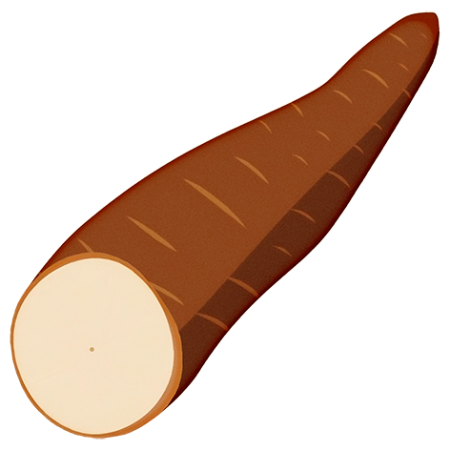
Cassava
A starchy root vegetable widely consumed in tropical regions. It’s versatile, used in both savory dishes and sweet treats, and is the source of tapioca.
240
medium root
(150 grams)
CAL
D
Nutri-Score
Energy-dense, rich in carbs, and a good source of vitamin C and potassium.
Value per 100 grams & per cup (130g) boiled:
160 kcal / 330 kcal
Protein
1.5 grams / 3 grams
Fats
0.3 grams / 0.5 grams
Carbohydrates
40 grams / 80 grams
Fiber
2 grams / 3.5 grams
Vitamins & Nutrients
- Vitamin C: Supports immune function and skin health.
- Folate (Vitamin B9): Essential for DNA synthesis and cell division.
- Iron: Supports red blood cell production and oxygen transport.
- Potassium: Maintains fluid balance and supports heart health.
Satiety and Feelings
Cassava is energy-dense with high carbohydrates but low in protein and fiber. It can keep you full longer, especially when paired with other foods.
What does 100 g look like?
A small to medium-sized piece of cassava root, or about 1/2 cup of boiled cassava.
What does 2000/2500 calories look like?
About 15 medium cassava roots (3 kg).
Daily Value per 100 grams %
Did you know?
- Cassava is native to South America but is now grown in tropical regions worldwide, especially in Africa and Asia.
Also known as manioc or yuca is one of the largest sources of calories for people in tropical regions, providing sustenance for millions of people around the world.
Cassava roots are naturally toxic in their raw state due to cyanogenic compounds, but proper preparation (peeling, soaking, and cooking) eliminates these toxins.
The plant is drought-resistant, making it an important crop in regions with irregular rainfall.
Cassava can be processed into flour (like tapioca) that is used in gluten-free baking and is a staple in many gluten-free diets.
Drawback
Cassava is very high in carbohydrates, which could cause blood sugar spikes if consumed in large amounts.
It is low in protein, meaning it is not a complete source of nutrition on its own.
Improperly prepared cassava can be toxic due to the presence of cyanide-producing compounds.