Bagel
Breadcrumbs

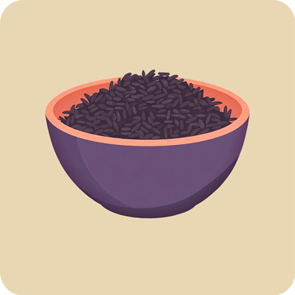
Black Rice
Black rice is a whole grain known for its striking dark purple-black color and high levels of antioxidants. Often called “forbidden rice,” it has a nutty flavor and chewy texture, popular in both savory and sweet dishes.
285
1 cup, cooked
(200 grams)
CAL
A
Nutri-Score
Rich in fiber, protein, and antioxidants.
Value per 100 grams & per cup (200gr):
145 kcal | 285 kcal
Protein
3 grams | 6 grams
Fats
0.5 grams | 1 gram
Carbohydrates
30 grams | 58 grams
Fiber
2.5 grams | 4.5 grams
Vitamins & Nutrients
- Iron: Supports oxygen transport in blood.
- Magnesium: Supports muscle and nerve function.
- Vitamin B1 (Thiamine): Important for energy metabolism and nerve function.
- Vitamin B6: Important for metabolism and brain health.
- Vitamin B9 (Folate): Supports cell growth and DNA synthesis.
- Vitamin E: Supports skin and eye health.
- Anthocyanins (Antioxidants): Protect against inflammation and oxidative stress.
Satiety and Feelings
Black rice is rich in fiber and protein, contributing to longer-lasting fullness and steady energy release compared to white rice.
What does 100 g look like?
About 1/2 cup uncooked black rice, roughly the size of a small handful.
What does 2000 | 2500 calories look like?
Approximately 5 ¾ cups uncooked (about 575 grams / 1.27 lbs).
Daily Value per 100 grams %
Did you know?
Black rice is sometimes called “forbidden rice” because it was reserved for Chinese emperors and forbidden to commoners in ancient times.
It contains some of the highest levels of anthocyanins found in any grain, which give it its rich black-purple color.
Different varieties include Indonesian black rice, Thai black jasmine rice, and Chinese heirloom black rice.
It is gaining popularity worldwide for its nutritional benefits and unique flavor.
Black rice can be used in both savory dishes and desserts, like traditional Chinese black rice pudding.
Drawbacks ⚠️
Longer cooking time compared to white rice.
Slightly higher cost due to lower availability.
May be harder to find in some grocery stores.
Contains phytic acid, which can reduce mineral absorption if eaten in excess.