Pork Roast

Quail

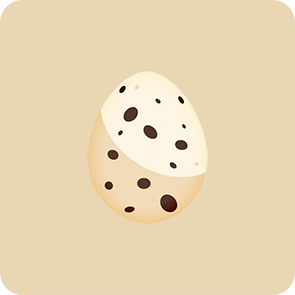
Quail Egg
Small but mighty, quail eggs have a delicate flavor and spotted shells. Often used in gourmet dishes and appetizers, they offer concentrated nutrition in just a few bites.
15
1 egg
(10 grams)
CAL
A
Nutri-Score
Nutrient-dense, high in vitamins B12, iron, and selenium, but also higher in cholesterol per gram than chicken eggs.
Value per 100 grams & per cup (200g):
160 kcal | 315 kcal
Protein
13 grams | 26 grams
Fats
11 grams | 22 grams
Carbohydrates
1 gram | 2 grams
Fiber
None
Vitamins & Nutrients
- Vitamin B12: Crucial for nerve health and red blood cell production.
- Iron: Helps transport oxygen throughout the body.
- Selenium: Powerful antioxidant that protects cells.
- Riboflavin (B2): Supports energy metabolism.
Satiety and Feelings
Though tiny, quail eggs are rich and satisfying due to their fat and protein content. Great as a quick snack or in small dishes that need a boost in nutrition.
What does 100 g look like?
About 10–11 quail eggs or roughly 2/3 cup raw.
What does 2000|2500 calories look like?
Around 125–155 quail eggs or 8–10 cups raw (about 1.8 kg / 4 lbs to 2.4 kg / 5.3 lbs).
Daily Value per 100 grams %
Did you know?
Quail eggs contain more nutrients per gram than chicken eggs, especially iron and vitamin B12.
Their shells are speckled and thin, making them easy to crack with a knife.
Popular in Japanese and Korean cuisine, often served raw over sushi or lightly boiled.
Despite their size, quail eggs have a yolk-to-white ratio that’s higher than chicken eggs.
They’re sometimes considered hypoallergenic for people who react to chicken eggs — but always consult a doctor first.
Drawbacks ⚠️
Very high in cholesterol per gram — about twice that of chicken eggs.
Smaller size means more handling, which can be inconvenient.
Expensive and less accessible in many regions.
Some may carry higher salmonella risk if eaten raw or undercooked, depending on source.