Empanada

Fried Shrimp
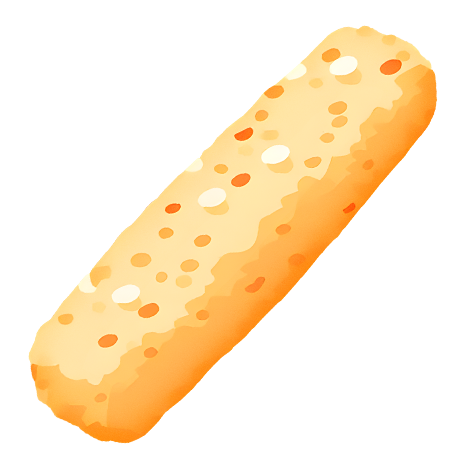
Fish Stick
A breaded and fried fish product made from white fish fillets, fish sticks are a convenient, kid-friendly option often served with dipping sauces.
110
1 stick
(50 grams)
CAL
B
Nutri-Score
Contains protein and omega-3 fatty acids, but often high in sodium and processed breading.
Value per 100 grams & per cup (150g):
220 kcal | 310 kcal
Protein
12 grams | 17 grams
Fats
11 grams | 15.5 grams
Carbohydrates
18 grams | 25 grams
Fiber
1.5 grams | 2 grams
Vitamins & Nutrients
- Omega-3 Fatty Acids: Support heart and brain health.
- Vitamin D: Supports bone health and immune function.
- Vitamin B12: Supports nerve function and red blood cell formation.
- Selenium: Acts as an antioxidant and supports immunity.
Satiety and Feelings
Fish sticks provide a moderate amount of protein and fat, which contribute to moderate fullness, but the breading and lower fiber content mean they may not keep you full for long.
What does 1 stick look like?
About the size of a finger, roughly 7 cm (2.75 inches) long, 2 cm (0.8 inch) wide, and 1 cm (0.4 inch) thick.
What does 100 g look like?
About 5 sticks or roughly ¾ cup.
What does 2000 | 2500 calories look like?
About 40 sticks or 6 cups (800 grams / 1.76 lbs.)
Daily Value per 100 grams %
Did you know?
Fish sticks were introduced in the 1950s as a convenient way to enjoy fish without the bones.
They’re typically made from white fish like cod or pollock, then breaded and fried or baked.
Many brands now offer gluten-free or baked versions for healthier options.
Fish sticks are a popular choice in children’s meals and quick dinners worldwide.
Drawbacks ⚠️
Often high in sodium, which may affect blood pressure if eaten excessively.
The processed breading adds refined carbohydrates and calories.
Fried versions can contain higher levels of saturated fats and trans fats.
As a processed product, may contain preservatives and additives.